
Emergency Air Duct Cleaning Near Me: What Rhawnhurst Homeowners Should Do First
If you’ve just spotted fuzzy growth around a supply register or caught a whiff of something dead coming from a vent, the instinct is to grab the phone and get somebody out here now. That instinct is understandable. It’s also, sometimes, the exact move that pushes contamination into every room of your Rhawnhurst home before anyone has figured out what’s actually going on. In our experience, the right order is assess, contain, then remediate. Skip the assessment and you can turn a bad afternoon into a week-long mess.
The sequence matters so much that it’s worth slowing down for ten minutes before you call anyone. This guide walks through which situations are genuine emergencies, which ones feel urgent but can safely wait 48 hours, and what to do with your own hands before a technician walks through the door. If you’d rather skip straight to a professional opinion, call (888) 301-3197. We answer 24/7, and fast dispatch runs from 7am to 7pm, Sunday through Friday.
Which situations are actually a duct emergency?
Only three scenarios rise to the level of a true duct emergency: a sewage backup that has reached or saturated ductwork, confirmed rodent intrusion inside the system, and post-fire soot that has been drawn into the air handler. Everything else, including musty smells, visible dust plumes, and a dusty film on the registers, is a scheduling problem, not a crisis. In our experience, most panicked calls to a Rhawnhurst duct cleaner turn out to be one of those three, or none of them.
Here’s how we think about the genuinely urgent cases:
- Sewage backup near ducts. If a sewer line has backed up into a basement or crawlspace where ductwork runs, the system can pull airborne bacteria into every room. This is a health-and-safety situation that needs professional containment, not a fan and a window.
- Confirmed rodent intrusion. Droppings, nesting material, or a smell that gets stronger when the heat or AC kicks on. Rodents leave behind pathogens and chewed insulation, and the contamination doesn’t clear on its own.
- Post-fire soot. Even a small kitchen fire sends fine soot particles into the return side of the system. Soot is acidic, it settles into the duct lining, and it keeps recirculating until it’s physically removed.
Everything outside those three categories can usually be booked into the normal schedule. A dead animal in a duct is unpleasant and worth addressing promptly, but it’s not a hazmat event unless the animal was diseased or the carcass has been there long enough to saturate the surrounding material.
What should you do in the first hour before a technician arrives?
In the first hour, your job is containment, not cleaning. Turn the system off at the thermostat, seal the registers in the affected rooms with painter’s tape and plastic sheeting, and keep people and pets out of those rooms. Don’t run a shop vac, don’t spray bleach into a vent, and don’t open access panels yourself. Each of those moves spreads contamination or risks damage to the duct lining, and a shop vac without HEPA filtration just aerosolizes whatever it picks up.
Follow this sequence:
- Shut the system off entirely if you have visible mold, a confirmed rodent problem, or soot. Running the fan recirculates the problem through the whole house.
- Seal the supply and return registers in the affected rooms with plastic sheeting and painter’s tape. Use tape that releases cleanly from paint and trim.
- Close the door to any room with an active contamination source and keep it closed.
- Ventilate adjacent living space by opening a window in a room that is not connected to the affected zone, weather permitting.
- Photograph everything before anyone touches it. More on that in the documentation section below.
One bit of gallows humor from years of doing this: the bleach spray bottle gets reached for more often than any other household item, and it’s almost always the wrong tool. Bleach on a porous duct lining doesn’t sanitize anything. It just makes the mold angry and adds a chemical smell to the problem.
Why does emergency duct cleaning need negative-air containment?
Emergency duct cleaning requires negative-air containment because the whole point is to capture dislodged contaminants before they escape into the room. A shop vac and a truck-mounted vacuum alone cannot do that. Negative air means the work area is held at slightly lower pressure than the rest of the house, so air flows into the containment zone instead of out of it. Without that, every brush stroke sends particles into the living room your family is sitting in.
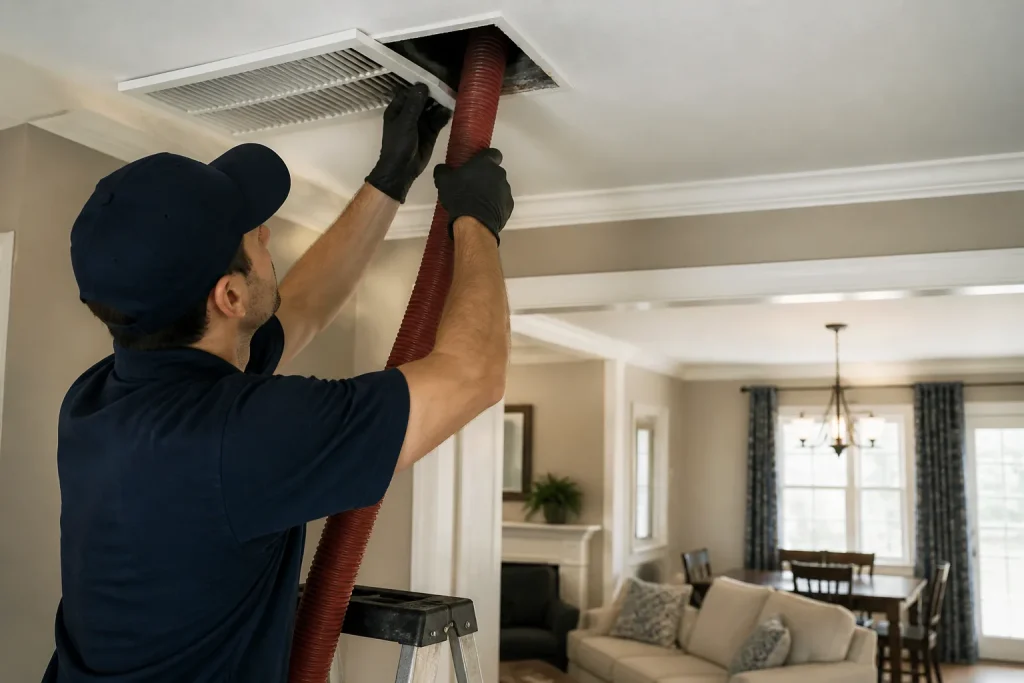
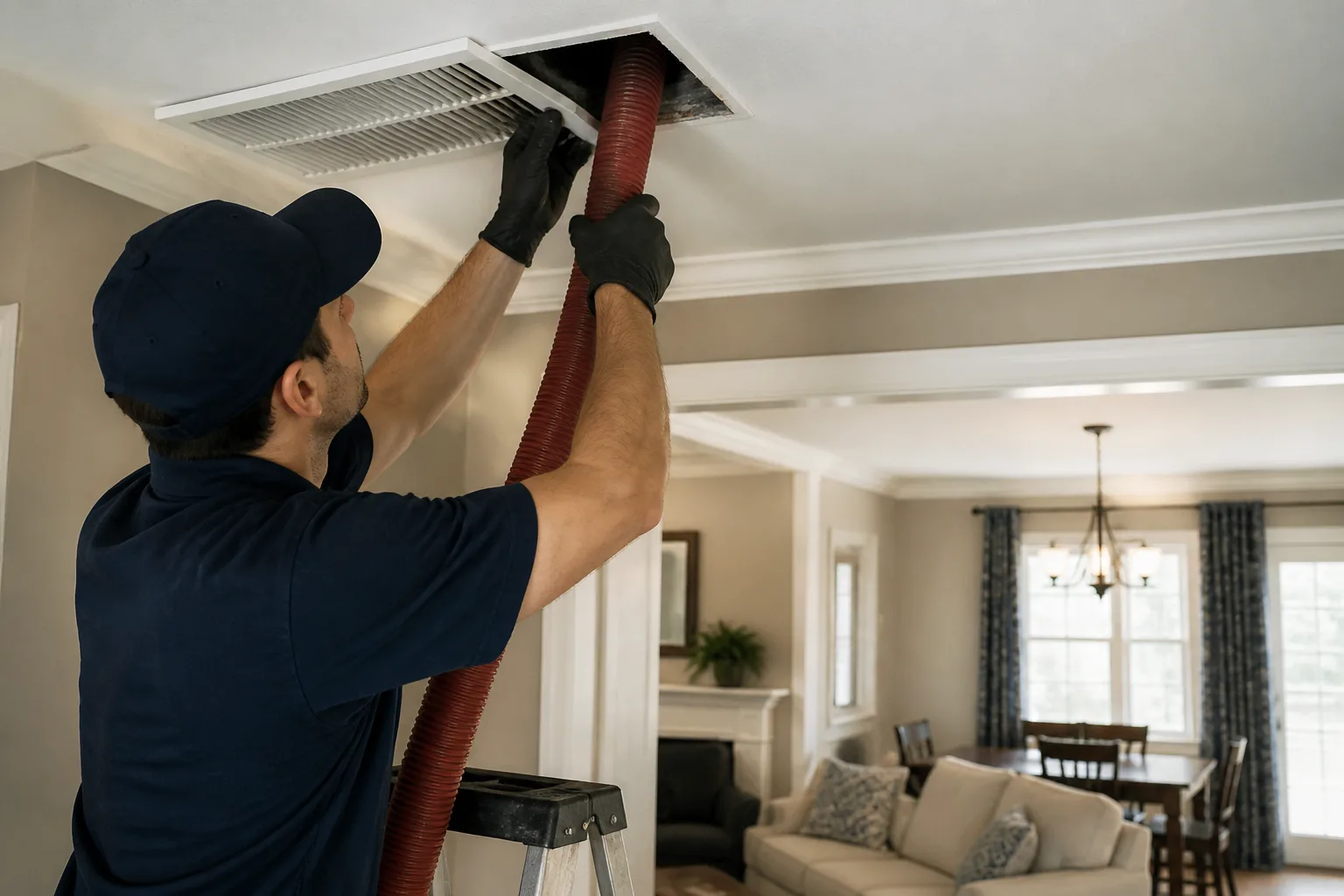
This is where equipment stops being a marketing bullet and starts mattering. Our technicians use Rotobrush rotary brush systems for contact cleaning inside the ducts, Nikro HEPA vacuum units to capture what the brush loosens, and Abatement Technologies air filtration equipment to keep the work area under negative pressure throughout the job. Those are the same categories of equipment commercial restoration contractors use, and they’re the reason a professional job looks different from a shop-vac attempt.
When you’re on the phone with any duct cleaner in Rhawnhurst, ask three questions directly:
- Do you set up negative air containment, and with what equipment?
- What filtration rating does your vacuum use?
- Will you show me before-and-after photos of my own ducts when the job is done?
A company that can’t answer those clearly is not set up for emergency work. That’s a useful filter, and it saves you from a bad outcome.
Who should you call first: the duct cleaner, the HVAC tech, or the remediator?
The order depends on what caused the problem. For a sewage backup, call a water remediation company first, then us for the ductwork once the source is stopped. For rodent intrusion, call pest control first to eliminate the animals, then duct cleaning to remove the contamination. For post-fire soot, the fire restoration contractor handles structural cleanup and coordinates duct cleaning as part of the scope. Calling the duct cleaner first in a Rhawnhurst home with an active sewage or rodent problem just means paying twice.
Where duct cleaning fits cleanly into the sequence is when the cause has already been handled and the system needs to be cleared. That’s also where air duct cleaning goes beyond just vacuuming. We clean it, seal it, and sanitize it, and we handle duct repair and sealing in-house, which means a compromised joint or a rodent-chewed section gets fixed on the same visit rather than leaving you to find a second contractor.
One more handoff worth knowing about: if your HVAC technician finds that a failed blower or a cracked heat exchanger has been pushing debris through the system, the HVAC cleaning side of the job has to happen after the repair, not before. Cleaning a system that’s still broken just means doing it again.
When should you call a pro instead of handling it yourself?
Call a pro the moment any of the three emergency scenarios applies, or the moment you find visible mold anywhere in the system. Mold in a supply register is a sign the problem extends into the ductwork, and a surface wipe doesn’t fix that. The same goes for any situation where contamination has clearly traveled through the return side of the system. That’s not a cleaning job for a homeowner with a vacuum and a weekend.
Related services in Rhawnhurst: if your dryer vent cleaning has been neglected and you’re noticing longer dry times or heat buildup behind the dryer, that’s a separate fire-safety concern worth addressing at the same time. Dryer vents are a dedicated service for us, not an upsell tacked onto a duct job, and a clogged vent is one of the more common causes of residential fires that homeowners simply don’t think about until something goes wrong.
Outside those cases, a dusty smell or a light film on the registers is a scheduled job, not an emergency. Book it, note the date, and move on with your week.
What documentation should you request after emergency duct cleaning?
Request four things after any emergency duct cleaning: before-and-after photos of the interior of the ducts, a written service report describing what was found and what was done, the equipment list used on the job, and the technician’s name and the date of service. These documents matter for three reasons. They support an insurance claim if the contamination was tied to a covered event. They protect your HVAC warranty if a manufacturer ever questions whether the system was properly maintained. And they help with future property disclosure if you ever sell the home.
We photograph the interior of the ducts before and after because it’s the only way a homeowner can verify the work actually happened. In our experience, this is the single biggest complaint about the duct cleaning trade, and it’s a fair one. Photos of your own system, timestamped, are the answer. If a company won’t provide them, that tells you something.
Keep the report with your home maintenance records. Post-fire and post-sewage jobs in particular generate documentation that an insurance adjuster may want to see months later.
The Bottom Line
Assess before you call, contain before anyone touches the system, then remediate in the right order. The three real emergencies are sewage near ducts, confirmed rodent intrusion, and post-fire soot. Everything else can usually wait 48 hours, and rushing it can make things worse. When you do call, ask about negative-air containment, HEPA filtration, and before-and-after photos, because those three answers separate a professional job from a shop-vac attempt.
If you’re in Rhawnhurst and need help, Air Duct Cleaning Rhawnhurst offers free estimates. Call (888) 301-3197. We answer 24/7, and fast dispatch runs from 7am to 7pm, Sunday through Friday. One flat price per system is agreed before work starts, and you’ll see photos of your own ducts when we’re done. Our technicians have up to 13 years of experience, and the local professional we connect you with is licensed and insured as their state requires.
Frequently Asked Questions
Emergency air duct cleaning in Rhawnhurst is priced per system, not per vent, and the written estimate you receive before work starts sets the final price. There’s no per-vent pricing and no teaser coupon that grows into a bigger invoice once the technician is on site. Call (888) 301-3197 for an exact quote; estimates are free.
No. A household vacuum without HEPA filtration aerosolizes mold spores and spreads them through the house, which makes the problem worse rather than better. Visible mold in a register usually means the growth extends deeper into the ductwork, and that requires contact cleaning plus HEPA capture under negative pressure. Call (888) 301-3197 so we can assess it properly.
Ask for before-and-after photos of the interior of your own ducts, a written service report, and the equipment list used on the job. Any company that won’t provide those is a company to avoid. We photograph the system before and after precisely so you can verify the work yourself. Call (888) 301-3197 for a free estimate.
Most homes don’t need duct cleaning on a fixed schedule. It’s driven by conditions: a renovation, a new pet, a rodent problem, a fire, or visible dust buildup in the system. In our experience, the honest answer is to clean when there’s a reason, not on a calendar someone else set for you. Call (888) 301-3197 if you want an assessment of whether your Rhawnhurst home actually needs it.
Written by the team at Air Duct Cleaning Rhawnhurst.
Need Air Duct Cleaning Help?
Call Air Duct Cleaning Rhawnhurst - the local pro we connect you with is licensed and insured, here with fast help in Rhawnhurst.
(888) 301-3197