
Top Signs You Need Air Duct Cleaning Service – Don’t Ignore These
Dusty supply registers are one of the least reliable indicators that your ducts need cleaning. More often than not, that dust points to a filter that’s past due or an airflow problem, not contamination inside the ductwork. The signs that actually matter are more specific, and most homeowners have never been told what they are. Here’s how to separate real contamination from cosmetic dust, so you know what you’re looking at before you call anyone. And if you’d rather have a trained eye look at it, call (888) 301-3197.
Register Dust vs. Duct Contamination: How to Tell the Difference
Surface dust on a register grille tells you very little about the duct behind it. Duct contamination is debris bonded to the interior wall of the duct itself, and that’s what cleaning is designed to remove. Here’s the flashlight test: pull a register cover, shine a light down the run, and check what’s stuck to the metal or flex liner rather than what’s sitting loose on the faceplate.
- Loose dust on the grille only: usually a filter or velocity issue. Check your filter first.
- Debris clinging to the inside wall of the duct: actual contamination. Dust, lint and debris that has settled and adhered is what professional equipment is built to address.
- Visible buildup you can scrape with a finger: heavy accumulation. This is the kind of thing a shop vac can’t reach and won’t fix.
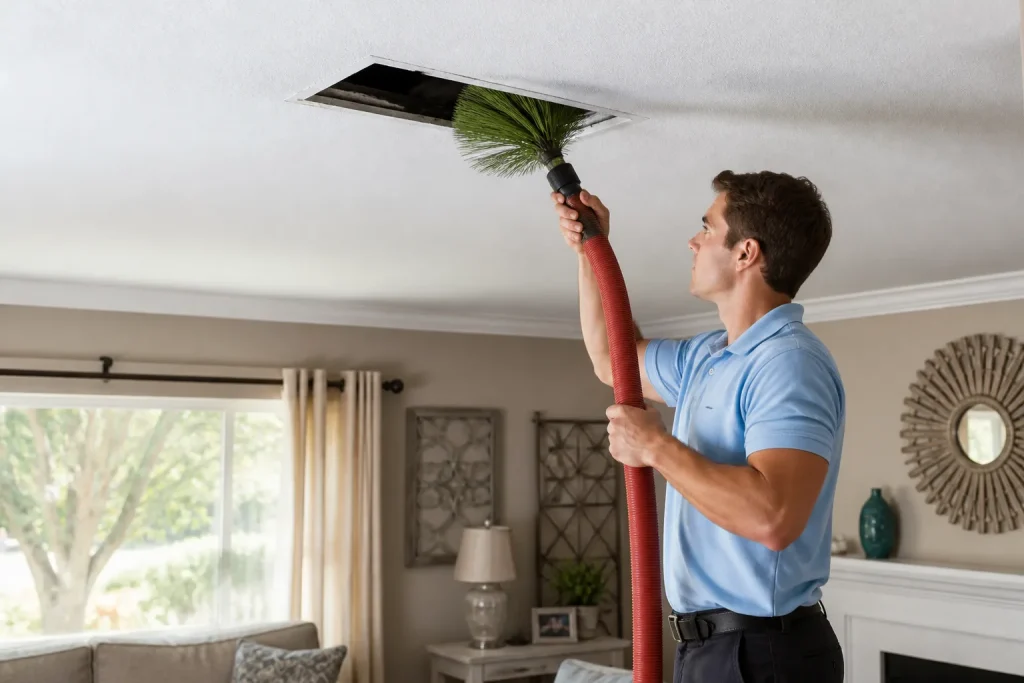
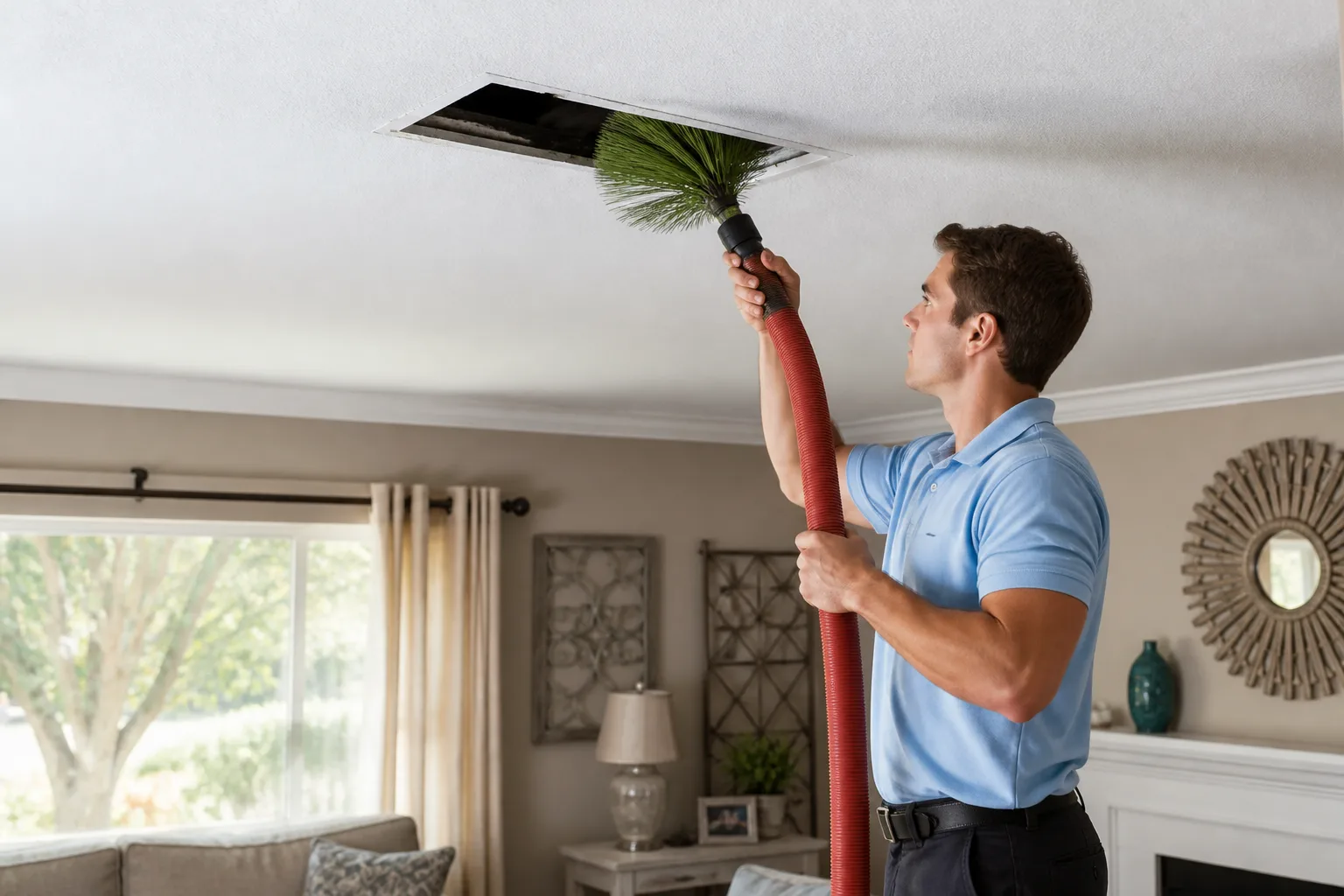
This distinction matters in Rhawnhurst, where a lot of homes have older galvanized trunk lines feeding newer flex runs. The trunk lines are where debris tends to collect because that’s where velocity drops. A flash of light down the trunk usually tells you more than a month of watching your vents. The right tools for this are contact-based: a rotary brush system that scrubs the duct wall, paired with HEPA extraction. We run Rotobrush rotary brush systems and Nikro HEPA vacuums for exactly this reason, and the difference between those tools and a handheld vacuum is not minor.
Why Uneven Airflow Across Rooms Is a Contamination Signal
If one room always feels stuffy while the rest of the house is fine, that’s worth a closer look. Debris accumulation in trunk lines changes the internal profile of the duct, which raises static pressure and reduces the volume of air that reaches the far runs. The room at the end of the longest run is usually the first to show it. On its own, uneven airflow could be a damper, a crushed flex run, or a filter loaded to the point of restricting flow. It becomes a cleaning signal when the pattern is consistent across seasons and the far rooms don’t improve after a fresh filter. That combination is where we usually find real buildup in the trunk. If ducts also show damage or gaps at the joints, sealing is the next step, and a full-system specialist can handle that in the same visit rather than sending you looking for a second contractor. In Rhawnhurst’s older housing stock, that kind of joint wear is common enough that we plan for it before we start.
Post-Renovation and Post-Pest Signs Most Homeowners Miss
Construction dust and pest intrusions leave traces that don’t show up in the obvious places. Both are easy to overlook because the visible part of the home looks clean once the drywall is up and the traps are set.
- Drywall dust inside flex duct. During a renovation, fine gypsum dust migrates into open registers and settles on the inside of flex runs. It coats the liner and clings in a way ordinary dust doesn’t. A filter catches some of it, but not the portion that’s already past the filter and settled inside the run.
- Rodent nesting material in unconditioned runs. Attic, garage and crawlspace runs are the usual landing spots. Look for shredded insulation, droppings, or a musty, animal smell that intensifies when that part of the system calls for air. This is one of the few signs where we recommend inspection sooner rather than later.
- A smell that returns after a filter change. If fresh filters don’t fix an odor coming from the vents, the source is downstream of the filter.
In Rhawnhurst, attic runs and older knee-wall duct paths are the ones we check first after a renovation or a pest issue. Abatement Technologies air filtration equipment is what we use during the work itself to capture dislodged material in the work area, so a post-renovation cleanup doesn’t turn into a dust event in the living room.
Why the First Heat of the Season Is Your Best Diagnostic Moment
The first time you run the heat each fall is the single best window for catching smell-based contamination. A system that sat idle for months has had time to accumulate settled dust, and the initial heat cycle disturbs it and pushes it into every room. If the smell is musty, earthy or vaguely like a wet basement, that’s a signal worth writing down.
There’s a second reason the season change matters. A dusty smell on first heat that fades after a day is usually just settled dust burning off. A smell that hangs on through the first week, or that gets stronger as the system runs, points to something in the duct or in the air handler that isn’t going to clear on its own. HVAC cleaning covers the components beyond the ducts themselves, which is often where the problem actually lives. Pay attention to whether the odor is present in every room or only some, and whether it changes when the blower speed changes. Those notes help your technician a lot. When we schedule a look in Rhawnhurst, we ask about that first-week pattern before we arrive.
The One Sign That Means Call Today, Not Next Month
Visible microbial growth or black debris around supply registers is the one sign that should move you past “schedule it eventually” and into “call now.” Black spotting, fuzzy growth at the seams of a register boot, or a spreading stain near a vent isn’t ordinary dust buildup. It usually points to moisture in the system, which is a different problem than simple debris. Moisture in ductwork tends to come from condensation, a leak, or a poorly sealed return pulling humid air from an unconditioned space. Cleaning alone won’t fix a moisture source, so the right response is to identify where the water is coming from and correct it before the system is cleaned. This is where duct repair and sealing capability matters: if a gap or a poorly sealed boot is letting humid air in, that gets found and fixed on the same visit rather than reported and left. We treat microbial growth as a “call today” item in Rhawnhurst, and we’d rather tell you that you don’t need cleaning than clean over something that will come right back.
What to Check Yourself Before You Call
Before scheduling anything, a quick pass through these items will tell you whether you’re looking at a real contamination problem or just a maintenance item:
- Change the filter and note whether the visible dust at the registers drops within a couple of weeks.
- Shine a flashlight inside two or three registers in different parts of the house, and note whether you can see debris clinging to the duct wall.
- Walk the house while the system runs and note which rooms feel weaker.
- Write down the smell, when it appears, and whether it fades.
- Check the dryer vent on the same pass. A dryer vent that takes too long to dry a load or feels hot at the exterior vent is a fire-safety issue, and it’s a separate service from duct cleaning.
When you’ve done that and the clues still point to real buildup, or the smell or pattern concerns you, it’s time for a trained look. Our technicians have up to 13 years of experience and can tell you on-site whether cleaning is warranted. Related services in Rhawnhurst include air duct cleaning, dryer vent cleaning and HVAC cleaning, all under one roof with a full-system specialist.
The Bottom Line
Don’t rely on dusty vents to tell you when to schedule air duct cleaning. Rely on the specific signs: debris clinging to the inside wall of the duct rather than the faceplate, airflow that’s consistently weaker in the far rooms, a smell that survives a filter change and returns with the first heat, and drywall dust or pest material in unconditioned runs. Any of those is worth a trained look. Black debris or visible growth around supply registers is worth calling today. If you’re in Rhawnhurst and need help, Air Duct Cleaning Rhawnhurst offers free estimates and works with leading air quality product brands including Honeywell and Aprilaire when filtration recommendations make sense for your system. Call (888) 301-3197.
Call (888) 301-3197. We answer 24/7. Fast dispatch from 7am to 7pm, Sunday through Friday. Closed Saturday.
Frequently Asked Questions
There’s no single schedule that fits every home. A home with pets, recent renovations, or allergies usually benefits from a look sooner than one with none of those factors. The practical answer is to inspect when you notice the specific signs in this article, not on a fixed calendar. Call (888) 301-3197 for a free estimate.
No. Dust at the registers is often a filter or airflow issue and clears up once the filter is changed. The real signal is debris bonded to the inside wall of the duct, which you can check with a flashlight past the grille. Call (888) 301-3197 to have a technician determine which is which.
Sometimes, and sometimes not. If the smell comes from settled debris, cleaning addresses it. If it comes from moisture or microbial growth, the moisture source has to be found and corrected first, which may mean repair and sealing. Call (888) 301-3197 for an exact assessment.
Register dust is loose material on the grille face, usually a filter or velocity problem. Duct contamination is debris bonded to the duct wall itself. A flashlight past the grille shows you which one you’re looking at. Call (888) 301-3197 for a free estimate.
Written by the team at Air Duct Cleaning Rhawnhurst.
Need Air Duct Cleaning Help?
Call Air Duct Cleaning Rhawnhurst - the local pro we connect you with is licensed and insured, here with fast help in Rhawnhurst.
(888) 301-3197